Due to significant interest in this particular design, a simple non-regulated switching symmetric power supply with a high power output of 350W has been developed.
It employs a Half Bridge configuration without regulation.
This power supply serves as an alternative to standard power supplies used in audio amplifiers, as traditional transformers and electrolytic capacitors for power amplifiers tend to be costly and bulky.
Moreover, transformers are unsuitable for portable devices due to their weight. However, it should be noted that this simplicity comes at a cost, as a short circuit or overload can damage the MOSFETs and other components.
Additionally, MOSFETs may experience stress during power-up as they need to charge the output capacitors.
Circuit Description
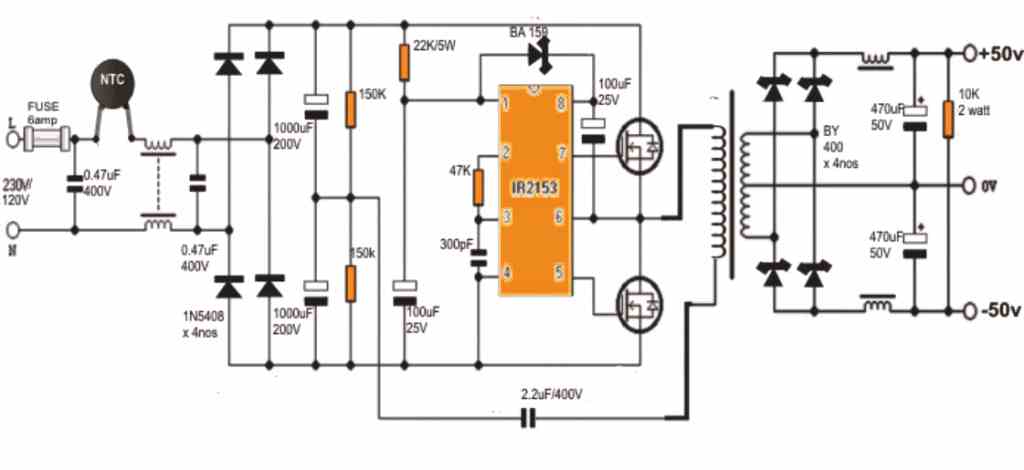
This very simple switch mode power supply circuit utilizes two N MOSFETs, driven by the integrated circuit IR2153.
Although this switching power supply lacks stabilization, it still provides a more stable and less noisy output voltage compared to a typical power supply, making it suitable for audio amplifiers.
The ripple at full load is less than 2V. To power the IR2153 circuit, a 27k 6W power resistor is employed. The built-in 15V Zener diode ensures voltage stabilization.
The operating frequency of the power supply is approximately 50kHz. To limit the peak current during capacitor charging, a thermistor is included at the input.
This thermistor can be salvaged from a faulty AT or ATX PC power supply. The transformer core is also sourced from any PC power supply.
Winding the Transformer
When winding the transformer, the primary winding is done first with 20 turns, followed by the secondary windings, and finally completing the rest of the primary winding.
This winding method minimizes leakage inductance, resulting in a more stable output voltage.
Adequate insulation must be maintained between the primary and secondary windings for safety reasons.
For increased safety, it is recommended to connect the output (i.e., center tap 0V) to the earth ground.
Chokes are incorporated to attenuate RF output ripple from the power supply.
The number of turns in the chokes is not critical, and various cores can be used, including those salvaged from PC power supplies.
To discharge the capacitors after switching off and prevent voltage spikes under no-load conditions, a 6k8 resistor is connected to the output.
Optionally, an LED can be connected in series with the resistor. The MOSFETs are mounted on a small heatsink, such as one sourced from a PC power supply, to dissipate heat effectively.

Thanks for your help.
Hello Brother!, I am Prakash Dutt from Delhi as i am a simple hobbiest of electronics world. where are you from brother?, can you please provide better schematic of (How to Build a Simple SMPS Circuit) because in the circuit there is not mentioned part name like, MOSFETs, Inductor Values etc. i will appreciate if you help me in my project of making SMPS!
Hello Bro, Thank you for your comment and for visiting my website, i am from Mumbai.
Regarding SMPS circuit, please note that the diagram shown in the article is intended mainly to show the basic operating subject of a simple half bridge SMPS using the IR2153 IC.
It is not a complete construction ready design which is why certain detail such as the MOSFET type, transformer specifications, wire gauge, ferrite core size and output inductor values are not included.
Unfortunately in SMPS circuit these limit cannot be specified independently.
They depend on a lot of factors, which has: Required output voltage Output current Output power Switching frequency Input voltage range Ferrite core type and size so, before selecting the transformer and other magnetic components, the exact output specifications must be known.
If you can give the following details, then I will try to suggest suitable design limit:
1. Required output voltage
2, highest output current
3, expected output power
4. Input supply voltage (230V AC or 120V AC) Once these specifications is available, it becomes possible to calculate the transformer turns ratio, select suitable MOSFETs and estimate the output filter components.